Disclaimer
The content represented within this document is current upon the date of publication. Some material may or may not apply to the user's individual circumstances due to differences in user role options enabled, and the user's specific client setup. Refer to the latest release notes for additional updates.
Prescribers and RxGov
RxGov is utilized by prescribers and their delegates to manage the Prescription Drug Monitoring Program (PDMP) workflow. It provides prescribers the ability to search and view patient dispenses, track their own prescribing history, manage, and receive notifications of patient prescription activity, and view their compliance with PDMP mandates.
Getting Started
The purpose of this document is to provide an overview of the system for users of RxGov with Prescriber role permissions enabled. It outlines the features of the system and provides instructions for use of the features available to Prescriber users.
*Note: For optimal results, RxGov should be run on a PC with the window maximized to full screen.
Creating an Account
Complete the following steps to create a Prescriber account in the RxGov system:
- Log in to the main RxGov site: https://{your unique URL}.rxgov.com.
- Click Register.
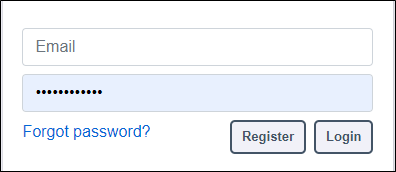
*Note: If configured, the user can select a default language and the option to display a legal disclaimer from the active link displayed in the lower right corner of the screen. Select the language with an active hyperlink (blue color) to change the default language throughout the application. Once a link is selected, RxGov is displayed in the selected language until the user changes the setting. If a user selects the Legal Disclaimer link, the disclaimer is displayed until the user closes it.

- Enter the following required personal details on the displayed RxGov registration form:
*Note: Your state's Admin may have enabled a custom privacy statement to display at the top of the registration form upon initial registration. If this privacy statement is displayed, please review it to better understand the site's data collection, use, and categories of information collected.
- Email (The email created here becomes your username)
- Password (Passwords must be at least 8 characters in length, contain uppercase and lowercase characters, and contain at least one special character and one digit.)
- Confirm Password
- First Name
- Last Name
- State
- Mobile Phone Number
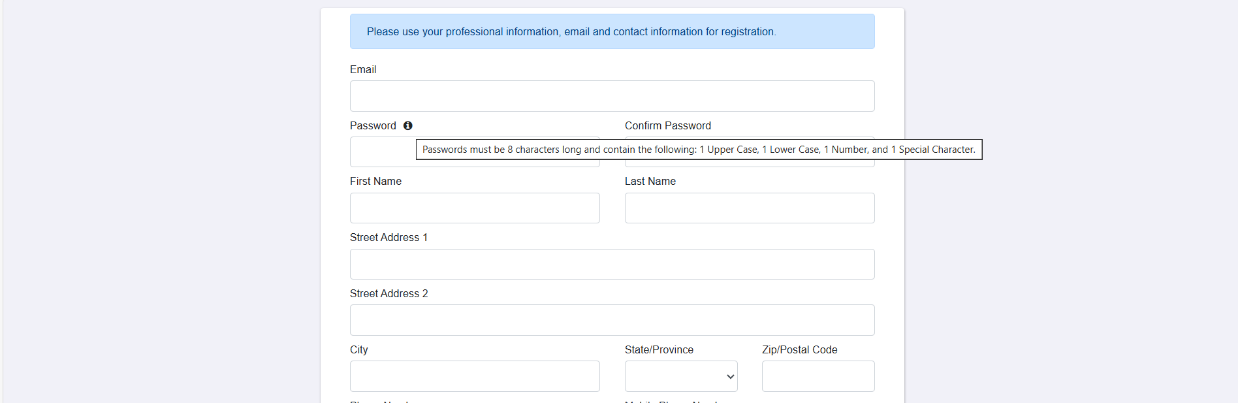
- Select Prescriber from the Account Type drop-down menu.
*Note: The following fields are only available when the Prescriber account type is selected.
- DEA Number
*Note: DEA number format and DEA file validation is automatically verified upon number entry. Incorrect format disables the Register button until a correctly formatted number is entered. If the DEA file validation fails, an error is displayed, but registration may continue.
- NPI Number
- User Type
- Specialty
- Organization(s)
- Click Register to complete the account creation.
*Note: When the Validated against prescriber list checkbox is selected on the User Management Options screen, and a Prescriber ID is not found in the Prescriber List file, then the following warning message is displayed: Provider ID not found in Provider List and the account is created. When this checkbox is not selected, the Prescriber ID is not validated and no warning messages display for invalid prescriber IDs. Whether or not a match is found, users may still register successfully.
- View the displayed Registration Complete message and verify that a message was sent to the email address associated with the account.
- Click the link provided in the confirmation email to confirm the email address.
- An RxGov Administrator will activate the account. Newly-created accounts must be activated by an RxGov Administrator before the user can proceed to log in.
- After the RxGov Administrator activates the new account, an Account Status Change email is sent to the email address associated with the account.
*Note: If a confirmation message is not received, check the Spam folder in the email application. If the message is not found, contact your Admin to have the confirmation resent.
**Note: For firewall reasons, some users may be unable to receive the DoNotReply@rxgov.com email containing the hyperlink to confirm their email account. In those cases, the user may need to whitelist IP address 149.72.202.144 to receive emails from DoNotReply@rxgov.com. - Once an Administrator has approved the account, open the RxGov URL and use the email address (username) and previously-created password to log into RxGov.
*Note: Prescribers with multiple organization affiliations must select the applicable organization at log in.
**Note: Some specific user roles may be restricted from gaining access to the RxGov portal. In such instances, those user role types are not available as an option during the account registration process and a message is displayed on the login screen with a URL link. Restricted users can click the link to be redirected to alternative login methods.
The Prescriber Engine
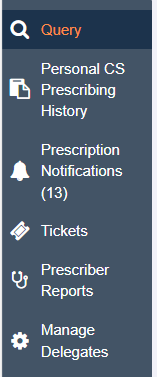
The Prescriber Engine provides users with the Prescriber role permissions enabled access to RxGov tools for managing Prescription Drug Monitoring Program (PDMP) compliance and PDMP prescriptions. When opened, the Prescriber Engine defaults to the Patient Query dashboard. All menu options are located on the left side of the screen. Available menu options displayed depend on which clinician features are enabled.
Patient Query
On the Patient Query dashboard, Prescribers can run queries to determine if patients comply with state Prescription Drug Monitoring Program (PDMP) mandates. Dispense detail results are available to view for each query. If no dispenses are found, RxGov displays the Query returned no results message. For individuals not found in RxGov, the No patients found for State message is displayed.
Performing Queries
Depending on the requirements of your state Prescription Drug Monitoring Program (PDMP), submitting a patient query request may require the following fields:
- First Name
- Last Name
- DOB
Complete the following steps to perform a query:
*Note: Required fields are marked with a red asterisk.
- On the Prescriber Engine, in the Query menu, on the Patient Query page, under the Patient Query tab, enter the required fields and any optional fields as necessary.
- Select the Species option to filter patient dispenses to view only Human or Non-Human dispenses. The default setting is to view All.
- Click Submit.
- View the query results displayed in the Patient Results section.
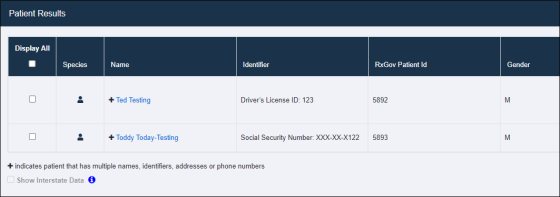
- (If configured and allowed by the state PDMP Admin) Click Print in the upper right corner of the displayed window to print query results.
*Note: If the Patient Query returns multiple patient records, and only some of those patient records are to be printed, select the checkbox of the patient record(s) to be printed. Click Print. Only the selected patient records are sent to the printer.
- Select the checkbox to the left of a patient name to display details about that patient dispense.
*Note: The icon in the Species column indicates if the patient is a veterinary patient or a human patient. Patients with multiple names, identifiers, addresses, or phone numbers are indicated in the results by a plus (+) sign. - In the Patient Information section, further information about the patient dispense is displayed in the Dispense Details tab.
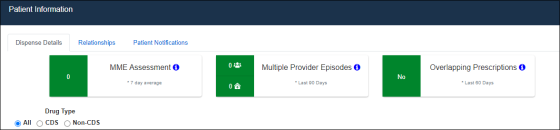
- (Optional) Your state PDMP may be configured to display patient-level alerts when a patient is selected. View one of the following three patient-level alerts to provide at-a-glance guidance on potential risks:
- MME Assessment – Morphine Milligram Equivalent (MME) Assessment evaluates the amount of morphine to which an opioid dose is equivalent and provides an average for patient dosage.
- Multiple Provider Episodes – Displays the number of prescribers and dispensers visited by the patient within a designated lookback period resulting in opioid dispenses.
- Overlapping Prescriptions – Displays the number of overlapping prescriptions for opioid and benzodiazepine dispenses within a lookback period.
- Select an option from the Filter drop-down menu to filter the number of months of patient query to display. The default filter setting displays the state-mandated period of months for review in patient queries.
- Select a Drug Type option to filter dispenses by drug type. The following options may be selected in the Drug Type field:
- CDS - Controlled Dangerous Substances
- Non-CDS - Non-Controlled Dangerous Substances
- All - (Default setting) The default view is for All dispenses.
- Dispenses are displayed under the Controlled Substance Dispenses or Non-Controlled Substance Dispenses labels under Dispenser Dispense Details according to type when filtered.
*Note: When no dispenses for the selected filter are found, a Query returned no results message is displayed. - Click the plus (+) sign in the left column to expand the group and view the individual dispenses. Click again to collapse the group back to one row. Alternatively, click the Expand All or Collapse All arrow to expand or collapse all results.
*Note: The state PDMP may be configured to display grouped dispenses with a plus sign (+) and a number in the left-hand column. The plus (+) sign indicates a group of dispenses of the same drug, defined as any dispenses where the generic ingredient, strength and dosage are the same. For example, identical prescriptions and prescriptions with refills. The number indicates the number of dispenses in each group. Click the minus (-) sign to collapse the group back to one row.
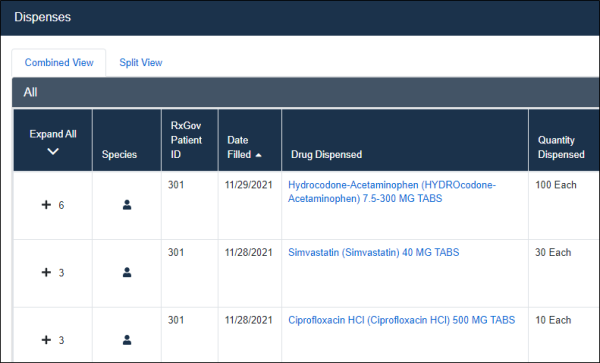
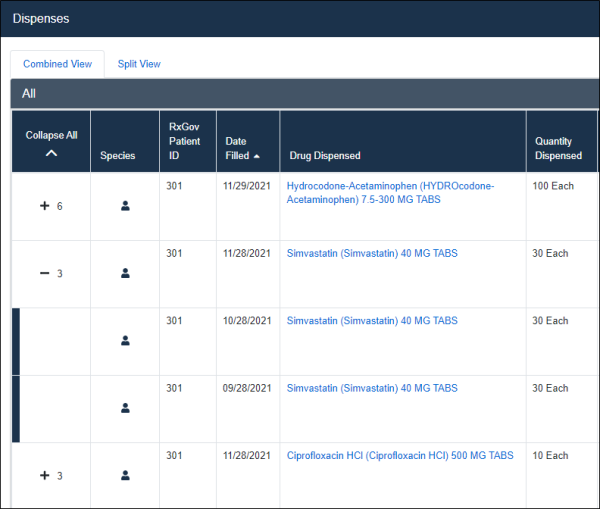
- To view details for a single dispense, click the name of the drug displayed in the Drug Dispensed column to display the dispense details.
- Click the X to return to the Dispense Results screen. If no dispenses are found, RxGov displays the Query returned no results message. For individuals not found in RxGov, the No patients found for State message is displayed.
Query parameters can be broadened to capture expanded results. In cases where the order of the patient names is uncertain, the query can be submitted to search for the names in any order. For example, if the patient name is listed as “Mason Morgan”, but could also be listed as “Morgan Mason”, the query can be configured to find all combinations.
To have the query search for names in any order, select the Search for any first and last name combinations checkbox in the Patient Query section.
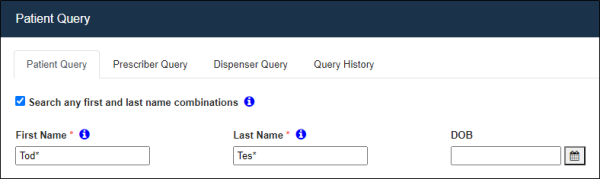
An additional search option, Search by Partial Name, may be available, subject to the configuration determined by the state PDMP.
To search by partial name for First Name, Last Name, or both, type the known letters in each field, followed by an asterisk, and click Submit (The minimum number of letters required for a search is determined by your state PDMP.).
*Note: If the number of letters entered is too few, a message is displayed, indicating the minimum number of letters required for the search.
Patient Relationships
Once a query is run, the relationship information between Dispensers and Prescribers is viewable in the results section.
Complete the following steps to view the relationships between Dispensers and Prescribers:
- In the Patient Results section of the query, select the checkbox to the left of a patient name to display details about that patient dispense.
- In the Patient Information section, click the Relationships tab to display further information. This tab defaults to the pie chart view and the number of past months selected in the Dispense Details filter.
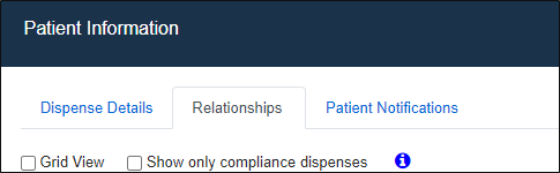
- In the pie chart view, hover over a color to see Dispenser or Prescriber details.
- (Optional) Select the Show only compliance dispenses checkbox to change the pie chart view to display only compliance dispenses.
- (Optional) Select the Grid View checkbox to view the relationship data in a table format.
- (Optional) When viewing multiple records for the same patient (for example, when Veterinarian dispenses are also returned), select the Merge Patients checkbox to combine records displayed in the pie charts.
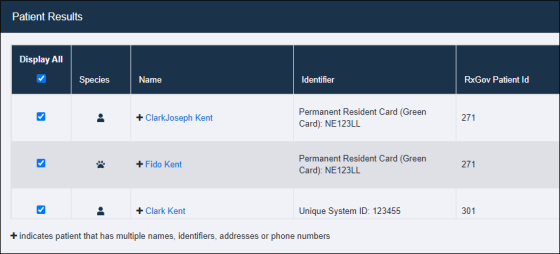
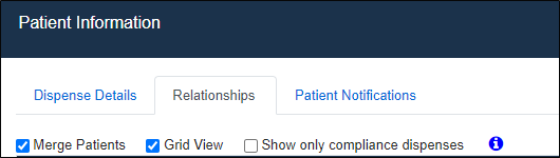
- View the displayed pie charts.
*Note: All dispenses found for the associated patient records are displayed in one Dispenser and one Prescriber pie chart to provide a single visual for each set of relationships.
Patient Notifications
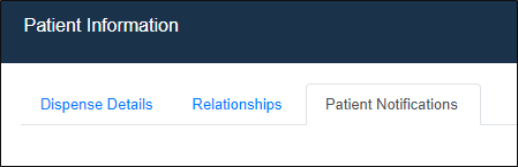
Notifications for prescriptions dispensed to the patient selected from the query results are available to view in the Patient Notifications tab under the Patient Information section.
Patient Management
Once a patient query has been run, a Prescriber can perform the actions described in the following sections for the selected patient by using the buttons in the Patient Results section:
Create New Prescription Notification
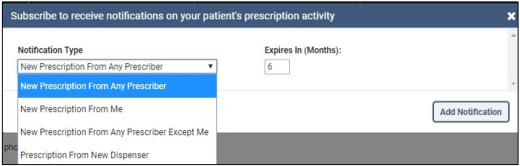
Prescription Notifications alert a Prescriber to patients with four prescription dispensing activity notification types listed below. This assists Prescribers in monitoring both their own prescribing as well as patient activity for easier oversight of prescribing within their patient population.
Notification Types:
- New Prescription From Any Prescriber.
- New Prescription From Me.
- New Prescription From Any Prescriber Except Me.
- Prescription From New Dispenser.
Complete the following steps to create a notification for the patient:
- In the Patient Results section of the query, click Create New Prescription Notification.
- Enter the following content in the Subscribe to receive notifications on your patient’s prescription activity window:
- Select the notification type from the Notification Type drop-down menu.
- Set the number of months for the notification in the Expires In (Months) field. The default number of months is 6.
- Click Add Notification.
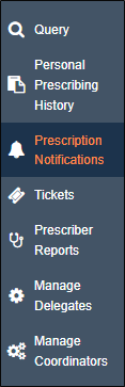
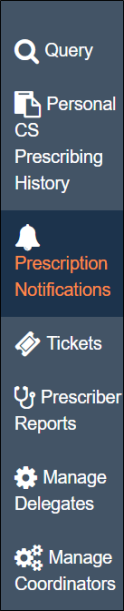
- (Optional) View the notifications on the main RxGov Prescriber Engine window, under the Prescription Notifications menu.
Report Patient Issue
Prescribers can submit a Report Patient Issue ticket to the state Prescription Drug Monitoring Program (PDMP) Administration.
Complete the following steps to submit a Report Patient Issue ticket:
- In the Patient Results section of the query, click Report Patient Issue.
- On the Create Patient Ticket window, in the Comment section, enter the message in the text field.
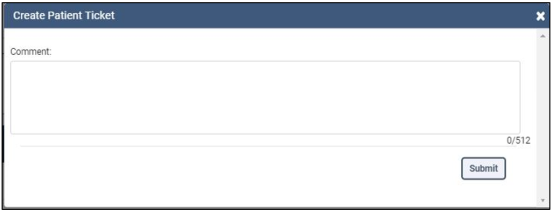
- Click Submit.
- Review the displayed Success window.
- (Optional) To view tickets, open the Tickets menu on the main Prescriber Engine page.
Flag for Merge
Prescribers can submit a Flag for Merge ticket in cases where duplicate patient records in RxGov are identified. Upon submission of Flag for Merge tickets, PDMP Administration reviews and merges the patient records to consolidate the dispense data.
Complete the following steps to submit a Flag for Merge ticket:
- In the Patient Results section of the query, select the checkbox to the left of the patient record(s) for all associated records to flag the record(s) for merge.
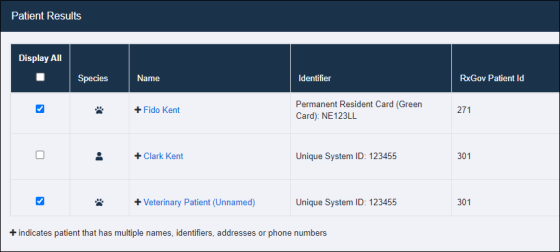
- Click Flag for Merge on the bottom right-hand corner.
- On the Create Merge Patients Ticket window, in the Comment section, enter any additional details in the text field for the PDMP Administrator to review.
- (Optional) Select the Please Select a RxGov Patient Id for Merged Patient Date of Birth checkbox.
- Click Submit.
- Review the displayed Success window.
- (Optional) To view tickets, open the Tickets menu on the main Prescriber Engine page.
*Note: Patients are not merged until the merge ticket is approved by a PDMP Administrator.
Query History
A query history is available for all queries performed by a Prescriber. On the main Prescriber Engine page, in the Query section, select the Query History tab to access historical queries.
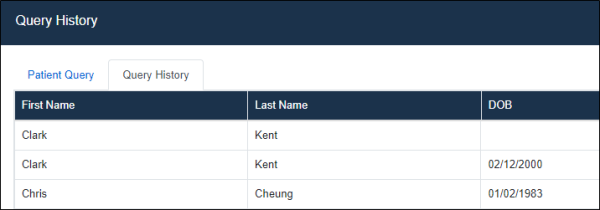
Rerun a Query
To rerun a query, click anywhere in the row of the displayed historical queries. When the historical query is clicked, the original query screen is displayed with the original parameters pre-populated. Click Submit to rerun the query.
Personal CS Prescribing History (Self-Audit)
The Personal CS Prescribing History screen displays a list of a prescriber’s dispensed prescriptions.
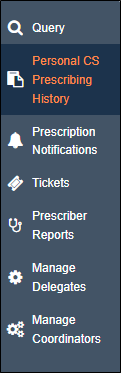
The default view on the Personal CS Prescribing History page in the My Prescriptions section displays the most recent 30 days of dispenses. Use the calendar menus for Start Date and End Date or enter a new date for either of those fields to filter dispenses. Click the column header, then click the white arrow to sort column data.
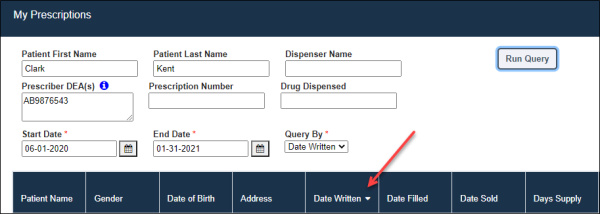
Each line provides basic details of the prescription. Click the row displaying a dispensed prescription to display the Dispense Details window and view additional patient and dispense details.
Prescription Notifications
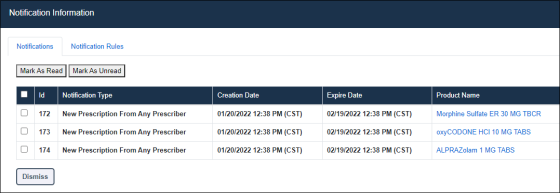
Prescription notifications allow Prescribers to view and manage notifications and notification alerts for individual patient dispense activity.
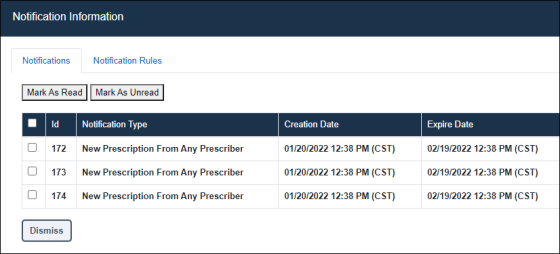
The default view on the Prescription Notifications page displays the Notification tab content of all notifications received within the past 30 days for active patient prescription notifications.
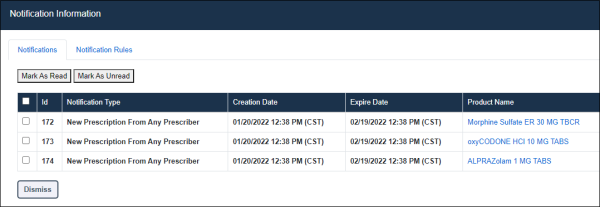
Complete the following steps to view or manage prescription notifications:
Notifications
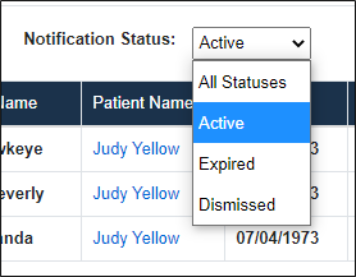
- On the Notification Information page, under the Notifications tab, select either All Statuses, Active, Expired, or Dismissed from the Notification Status drop-down menu to filter notifications.
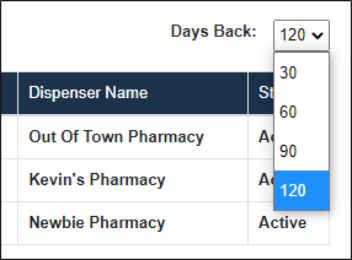
- Select the 30, 60, 90, or 120 day option from the Days Back drop-down menu to refine the recent number of notifications displayed.
- (Optional) Select the checkbox to the left of the notification(s), then click Mark As Read or Mark As Unread to change the status of the selected notification(s).
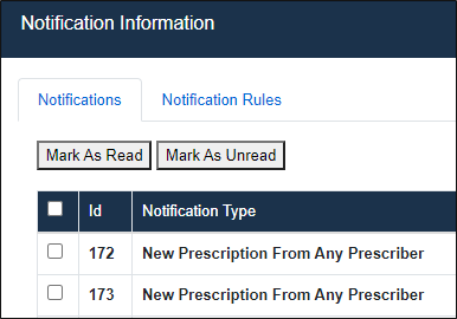
- (Optional) Select the checkbox to the left of the notification(s), then click Dismiss to dismiss the selected notification(s).
*Note: Click the checkbox on the top row above the list of notifications to select all visible notifications for inclusion in the actions described above.
- Review the message in the displayed Confirm window and click either Yes or No to complete the dismissal process or to cancel the dismissal.
Notification Rules
The Notification Rules tab provides the ability to view and manage patient prescription notifications created through Patient Query.
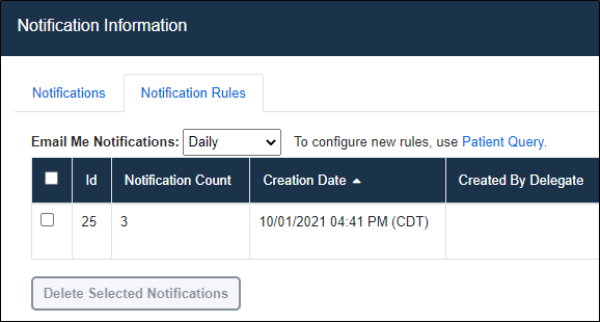
Complete the following steps to manage notification rules under the Notifications Rules tab:
- On the Notification Information page, under the Notifications Rules tab, select either Immediately, Daily, Weekly, or Never from the Email Me Notifications drop-down menu.
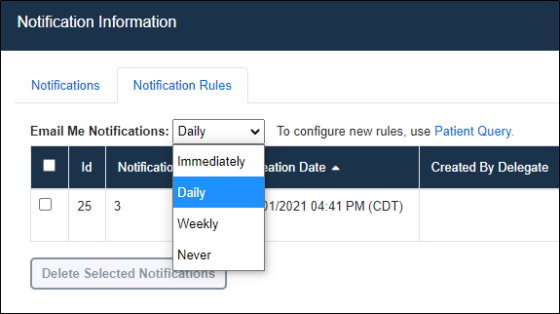
- (Optional) Click the pencil icon
 at the end of the notification row to edit the notification. Update the following content in the displayed Edit Prescriber Notification Rule window:
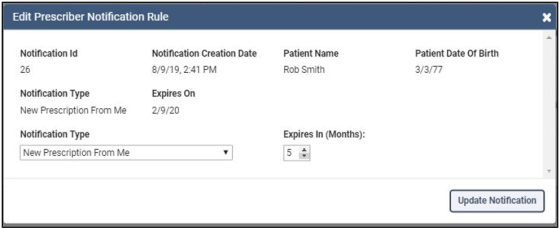
- Select an option from the Notification Type drop-down menu to change the Notification Type.
- Select a duration for the notification by entering a different number in the Expires in (Months) field or use the directional arrows to set a different length of time for the notification.
- Click Update Notification to complete the edit process.
Tickets
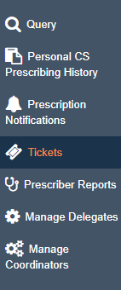
The Tickets menu displays all Prescriber tickets sent to Prescription Drug Monitoring Program (PDMP) Administration for approval. For example, user identifier change requests, patient issues, and patient merge requests.
If a change request is submitted incorrectly, it can be rescinded. To rescind a request, click the Rescind checkbox next to the Ticket ID, then click Rescind.
*Note: Tickets may be rescinded as soon as they are displayed in the Tickets menu. However, once a ticket has been resolved by an Admin, it can no longer be rescinded.
Once a ticket is rescinded, a Success window is displayed to confirm that the process has completed.
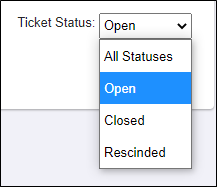
Tickets can also be sorted by status. Select an option from the Ticket Status drop-down menu to sort the displayed tickets by status.
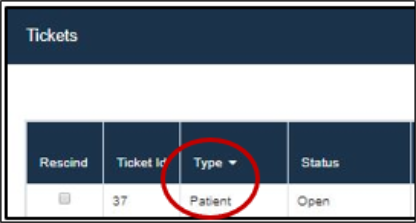
Tickets can also be sorted by column content. Click a column header, then click the white arrow to sort the contents of a column.
View Prescriber Reports
The Prescriber Reports menu provides prescribers the ability to view their compliance with Prescription Drug Monitoring Program (PDMP) mandates and determine their performance compared to peer compliance for any month prior to the current month.
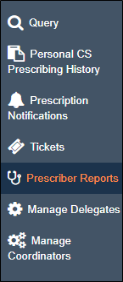
*Note: Access of the Prescriber Reports menu is dependent upon configuration established by system administrators. Not all options represented are displayed in every configuration.
View a Prescriber Dashboard Report
Complete the following steps to view Prescriber Insights, Unsolicited Reports, Personal CS Prescribing History, Buprenorphine Report, or Prescriber Utilization:
On the Prescriber Reports menu, click the appropriate tab for the type of report you would like to view.
- Prescriber Insights
- Buprenorphine Report
- Prescriber Utilization
- Personal CS Prescribing History
- Unsolicited Reports

Prescriber Insights
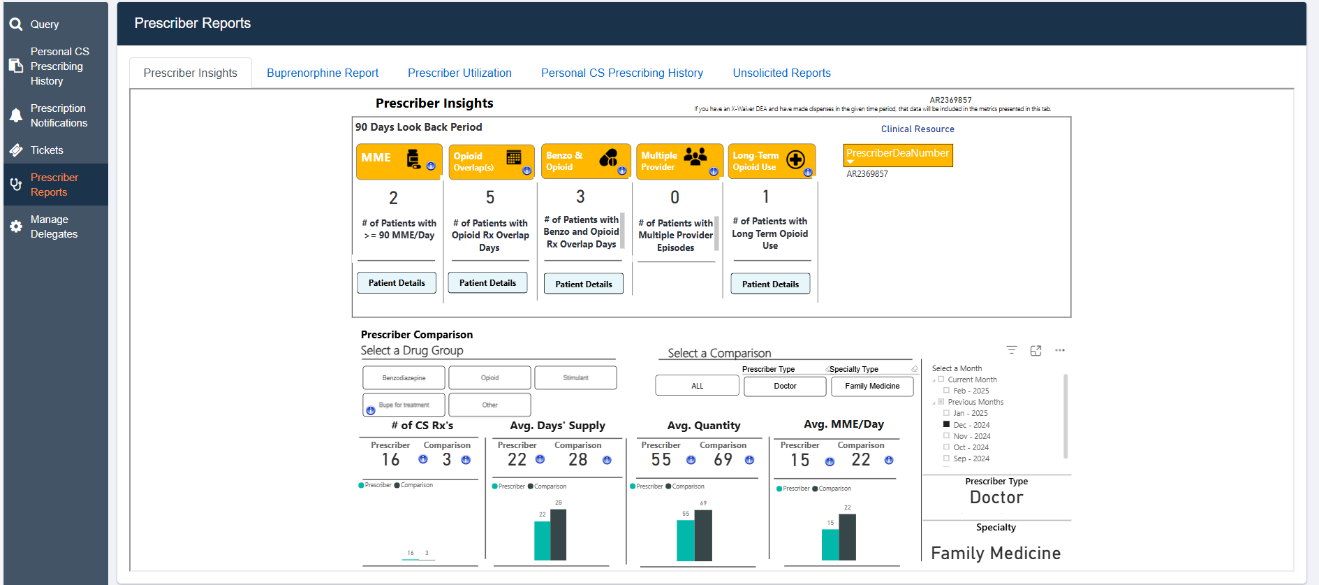
The Prescriber Insights Report feature displays details regarding dispenses submitted to patients. Prescribers may select variables such as Drug Type, Date Range, and Comparison Type to view refine the report details.
Complete the following steps to view a Prescriber Insights report:
- On the Prescriber Dashboard, in the Prescriber Reports section, open the Prescriber Insights tab.
- Review the following patient metrics:
- Morphine Milligram Equivalent (MME)
- Opioid Overlap
- Benzo & Opioid
- Multiple Provider
*Note: When a Prescriber or a Pharmacy has both DEA and XDEA number dispenses prescribed under XDEA, the numbers are combined into a single DEA number.
- Long-Term Opioid Use
- Prescriber Comparison
- Drug Group
- Month/Date
- Comparison Type
- Number of Controlled Substances Rx’s
- Average Day’s Supply
- Average Quantity
- Average MME
Unsolicited Reports
The Unsolicited Reports feature displays a list of unsolicited notifications received. When patients under a prescriber's care have any of the following unsolicited notification events, prescribers are notified via an email notification containing no personal health information (PHI):
- High Daily MME Notification
- Multiple Provider Alert Notification
- Dangerous Drug Combination Notification
- Early Controlled Substance Refill Notification
Complete the following steps to view Unsolicited Notifications:
- On the Prescriber Dashboard, in the Prescriber Reports section, open the Unsolicited Reports tab.
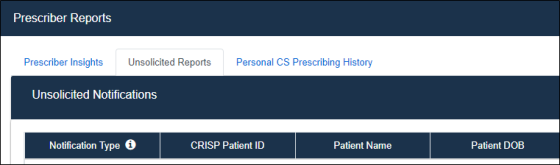
- Review the following displayed notification data for each patient:
- Notification Type
- Patient ID
- Patient Name
- Patient DOB
- Email Notification Status
- Survey Number
- Letter Generated Date
- Time Range
- Letter Viewed Status
Personal CS Prescribing History
The Personal CS Prescribing History feature displays a list of a prescriber’s dispensed prescriptions up to a specified range of (X) days.
Complete the following steps to initiate a self-audit of prescriber dispenses:
- On the Prescriber Reports menu, under the Prescriber Dashboard tab, open the Personal CS Prescribing History tab.
- (Optional) Refine the report by selecting the Query By field options, the Start Date, and the End Date.
*Note: The date range parameters entered for Start Date and End Date must be within the range established in the configuration. If a date range which exceeds that configuration is entered, an error message is displayed. - (Optional) Click Run Query.
- Review the displayed data for each dispense for accuracy.
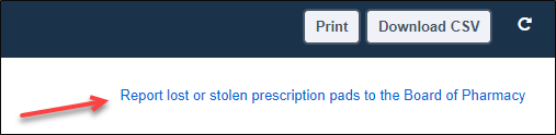
*Note: An external link may be displayed on the Self-Audit report if this feature has been configured by the Admin. When clicked, the link directs the user to an external URL allowing the user access to information relevant to the content on the report.
Buprenorphine Report
A Prescriber user may view the Buprenorphine Report to observe how many patients a prescriber has on an active buprenorphine prescription and evaluate peer comparison metrics.
Complete the following steps to view a Buprenorphine Report:
- On the Prescriber Reports menu, under the Prescriber Dashboard tab, open the Buprenorphine Report tab.
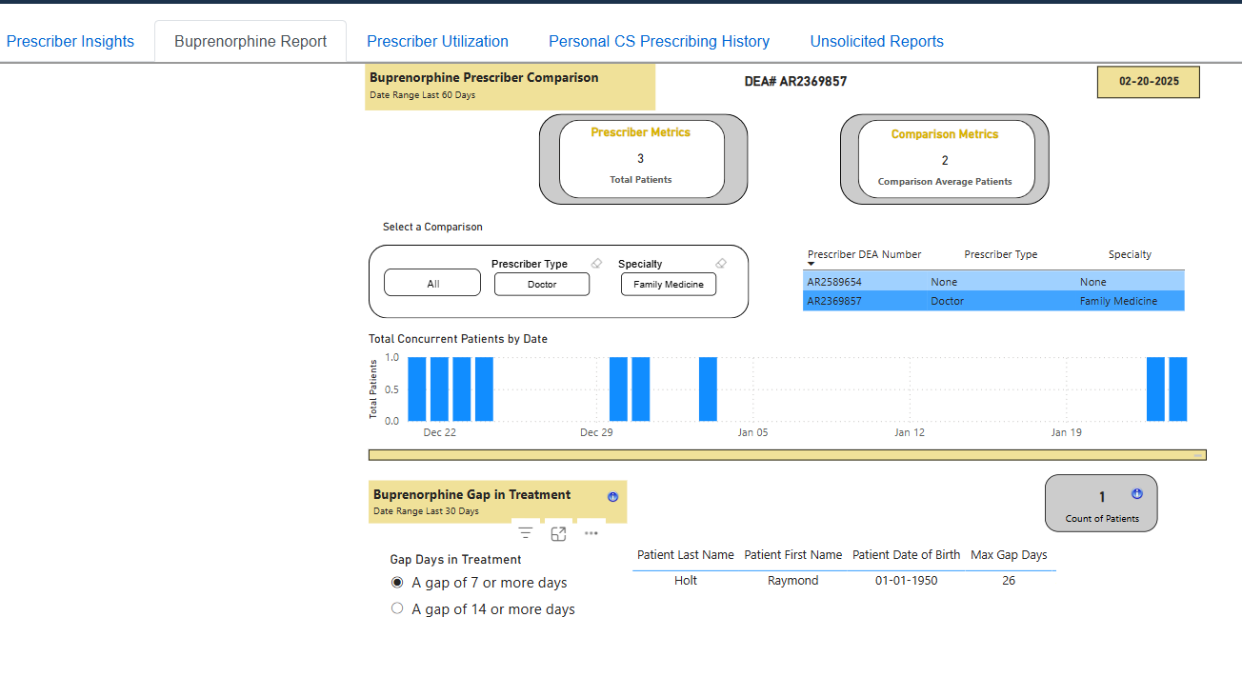
- Review the displayed data for number of patients on buprenorphine prescriptions in the previous 60 days.
- (Optional) Refine the report by selecting the Comparison Prescriber Type and Specialty field options.
- Use the Buprenorphine Gap in Treatment section to identify patients that have experienced a gap of 7 or more days, or 14 or more days in buprenorphine prescriptions in the previous 30 days.
Prescriber Utilization
Complete the following required steps and any optional steps as necessary to run and view a Prescriber Utilization report:
*Note: The Prescriber Utilization and Prescriber Dashboard tabs are displayed only when enabled and configured for the individual tenant.
- On the Prescriber Reports menu, click the Prescriber Utilization tab to display the Prescriber Insights content for the default month.
*Note: Click the Change Month link to select a different month of data to review.
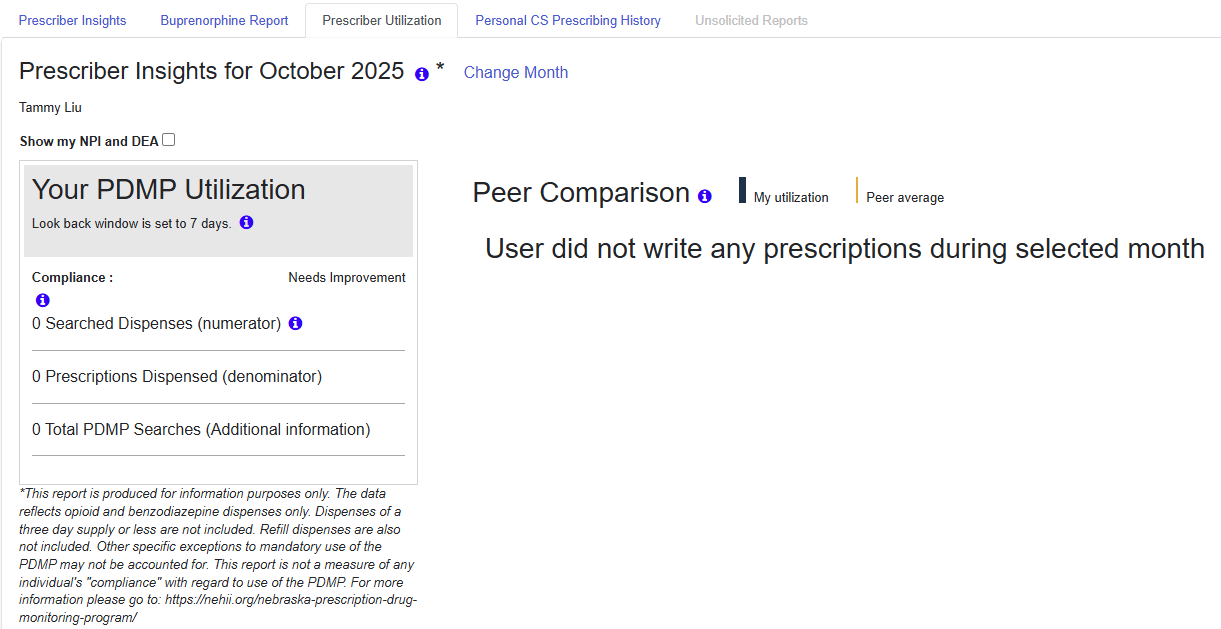
- On the Prescriber Utilization tab, click Run to display the Prescriber Utilization report details.
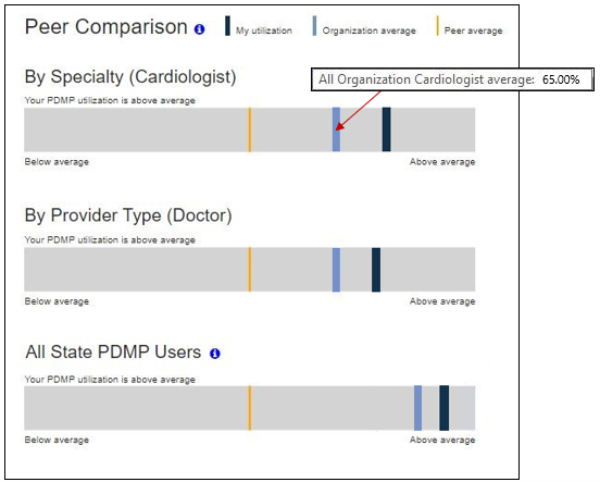
The Peer Comparison displays PDMP utilization data for the prescriber relative to others in their organization by Specialty, Provider Type, and All State PDMP Users. The calculation is based on the average number of searched dispenses compared to average number of searched dispenses by the peer group. The Peer Comparison allows the prescriber to assess how effectively they are utilizing the PDMP compared to their peers.
The mid-point of each bar is the average use of your calculation based on the queried dispenses compared to the peer group. The mid-point of each chart is the average utilization of the peer group. The ends of the bar are two standard deviations from the average (two standard deviations below, two standard deviations above).
Hold the pointer over the bar in each section to view the utilization percentages for that group (See example: All Organization Cardiologist average: 65.00%).
Manage Delegates
Prescribers have the option to establish Prescriber Delegates who can manage patient queries and patient prescription notifications on the prescriber’s behalf. When enabled by Prescription Drug Monitoring Program (PDMP) Administration, Prescriber Delegates can create prescription notifications, perform and view patient dispense queries, report patient issues, flag duplicate patient records for merging, and view the Prescriber’s prescription history.
When selected, the Manage Delegates menu defaults to the My Delegates tab.
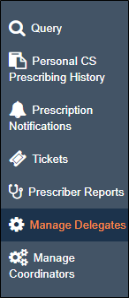
Complete the following steps to manage Prescriber Delegates:
- On the Manage Delegates menu, in the Manage Delegates section, click the Add New Delegate tab to add a new delegate.
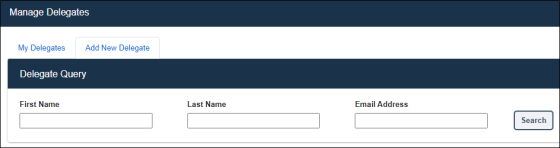
- In the Delegate Query section, enter criteria in one or more of the following fields to search for a delegate:
- First Name
- Last Name
- Email Address
*Note: Partial entries in any of the Delegate Query fields return results based on the content entered. For example, when Mi is entered into the First Name field, results are displayed to include all first names beginning with Mi: Michael, Michelle, Mitch, etc.
- Select the desired delegate from the results returned and verify that the delegate’s RxGov registration status is active.
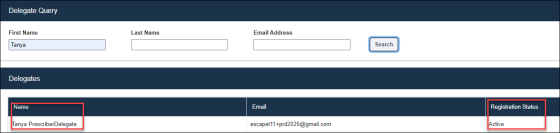
- Click Make Delegate to create the new delegate.
- Review the content of the displayed Confirm Expiration Date window.
*Note: An expiration date for the delegate relationship is required. To change the default date, select a new date in the calendar menu or enter a new date in the Expiration Date field.
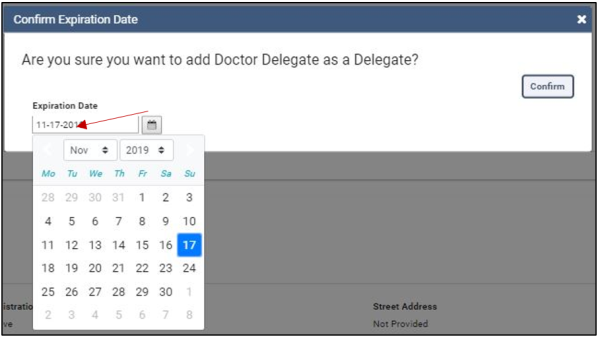
- Click Confirm to request the delegate relationship.
- Review the content of the displayed Status Changed window.
- On the Manage Delegates page, under the My Delegates tab, review the Relationship Status of the new delegate. The requested delegate status is displayed as Pending until the delegate activates the relationship.
- (Optional) As a Prescriber, use Edit Expiration Date or Deactivate options from the My Delegates window to edit the expiration date for a delegate relationship or to deactivate delegates.
The Prescriber Delegate Engine
The Prescriber Delegate Engine provides Prescriber Delegate users access to RxGov tools for managing Prescription Drug Monitoring Program (PDMP) compliance and PDMP prescriptions on behalf of prescribers with whom they have established a relationship in RxGov. When opened, the Prescriber Delegate Engine defaults to the Patient Query screen. All menu options are located on the left side of the page.
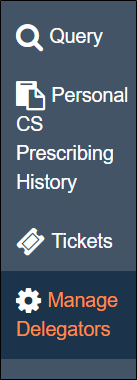
*Note: For optimal results, run RxGov on a PC with the window maximized to full screen.
Manage Delegators
Prescriber Delegators must have an established active relationship with a Prescriber prior to gaining access to any of the available features in their dashboard. When there are no delegator (prescriber) relationships present, a warning message is displayed for the delegate when they log in, indicating that there are no active delegators.
Before a delegate can gain access to the features available, a prescriber must first request the relationship with a delegate. To establish the relationship, the Prescriber Delegate must then activate the requested connection.
Complete the following steps to activate the Prescriber Delegate relationship connection:
- On the Prescriber Delegate Engine, select the Manage Delegates menu.
- In the Manage Delegates section, review the displayed list of all prescribers with whom the delegate currently has, or has had a relationship. The Relationship Status column indicates if the relationship is active.
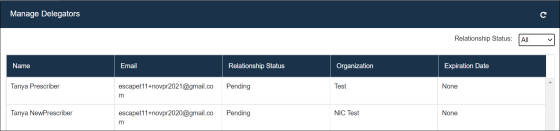
- Select the desired Prescriber from the list. The relationship status should display as Pending.
- Review the Prescriber Details displayed on the bottom half of the screen.
- Click Activate.
- Review the displayed Confirm window to verify the successful activation of the relationship.
- (Optional) In the Confirm window, select Yes or No to set the Delegator as the current Delegator.
*Note: When more than one Delegator is associated with the Delegate User, the Set As Current Delegator option is displayed.- If Yes is selected, a message is displayed to confirm the Prescriber’s status as current Delegator.
- If No is selected, a message is displayed advising that there is no current Delegator.
- (Optional) Click Deactivate in the Prescriber Details section to deactivate a relationship with a Delegator.
- Review the displayed Status Changed window to verify the successful deactivation.
Switch Between Delegators
Prescriber Delegates can have more than one prescriber relationship. Prescriber Delegates can change to a different prescriber relationship if needed.
Complete the following steps to switch the current prescriber relationship to another prescriber relationship:
- On the top menu bar, click the Prescriber name displayed to the right of on behalf of.

- On the displayed Select Delegator window, highlight the desired prescriber, then click Select Delegator.
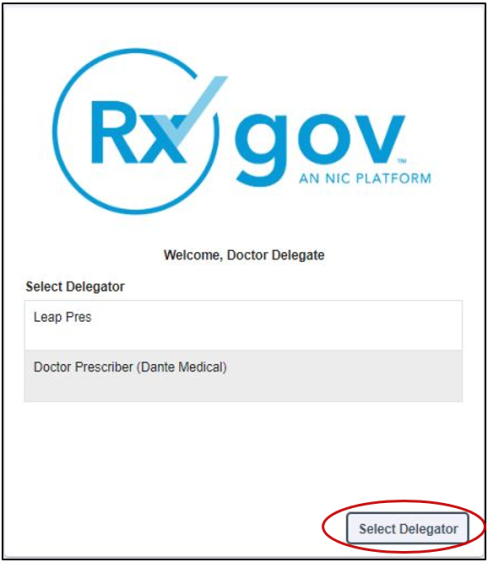
- Verify that the new Prescriber name is displayed in the top menu to the right of on behalf of.

Performing Patient Queries
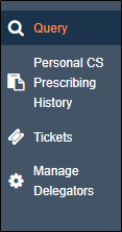
Prescriber Delegates can run a query on patients on behalf of a Prescriber to comply with state Prescription Drug Monitoring Program (PDMP) mandates. Dispense detail results are available to view for each query.
If no dispenses are found, a Query returned no results message is displayed in RxGov. For individuals not found in RxGov, the No patients found for State message is displayed.
Depending on the requirements of your state PDMP, submittal of a patient query request may require the following fields:
- First Name
- Last Name
- DOB
*Note: Required fields are marked with a red asterisk.
Complete the following steps to perform a Patient Query:
- On the Prescriber Engine, in the Query menu, under the Patient Query tab, enter the required fields and any optional fields as necessary.
- Select the Species option to filter patient dispenses to view only Human or Non-Human dispenses. The default setting is to view All.
- Click Submit.
- View the query results displayed in the Patient Results section.
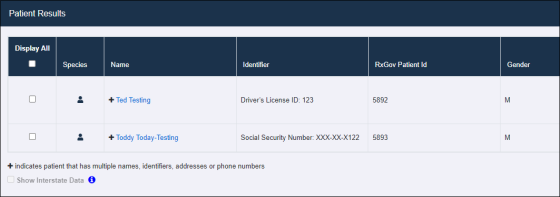
- Select the checkbox to the left of a patient name to display details about that patient dispense.
*Note: The icon in the Species column indicates if the patient is a veterinary patient or a human patient. Patients with multiple names, identifiers, addresses, or phone numbers are indicated in the results by a plus (+) sign. - In the Patient Information section, click the Dispense Details tab to display further information about the patient dispense.
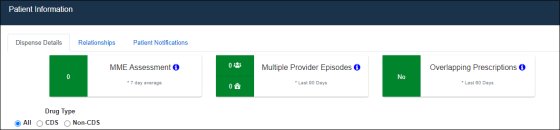
- (Optional) Your state PDMP may be configured to display patient-level alerts when a patient is selected. View the following 3 patient-level alerts to provide at-a-glance guidance on potential risks:
- MME Assessment – Morphine Milligram Equivalent (MME) Assessment evaluates the amount of morphine to which an opioid dose is equivalent and provides an average for patient dosage.
- Multiple Provider Episodes – Displays the number of prescribers and dispensers visited by the patient within a designated lookback period resulting in opioid dispenses.
*Note: When a Prescriber or a Pharmacy has both DEA and XDEA number dispenses prescribed under XDEA, the numbers are combined into a single DEA number. - Overlapping Prescriptions – Displays the number of overlapping prescriptions for opioid and benzodiazepine dispenses within a lookback period.
- Select an option from the Filter drop-down menu to filter the number of months of patient query to display. The default filter setting displays the state-mandated period of months for review in patient queries.
- Select a Drug Type option to filter dispenses by drug type. The following options may be selected in the Drug Type field:
- CDS - Controlled Dangerous Substances
- Non-CDS - Non-Controlled Dangerous Substances
- All - (Default setting) The default view is for All dispenses.
- Click Search. Dispenses are displayed under the Controlled Substance Dispenses or Non-Controlled Substance Dispenses labels under Dispenser Dispense Details according to type when filtered.
*Note: When no dispenses for the selected filter are found, a Query returned no results message is displayed. - Click the plus (+) sign in the left column to expand the group and view the individual dispenses. Click again to collapse the group back to one row.
*Note: The state PDMP may be configured to display grouped dispenses with a plus sign (+) and a number in the left-hand column. The plus (+) sign indicates a group of dispenses of the same drug, defined as any dispenses where the generic ingredient, strength and dosage are the same. For example, identical prescriptions and prescriptions with refills. The number indicates how many dispenses are in the group. Click the minus (-) sign to collapse the group back to one row.
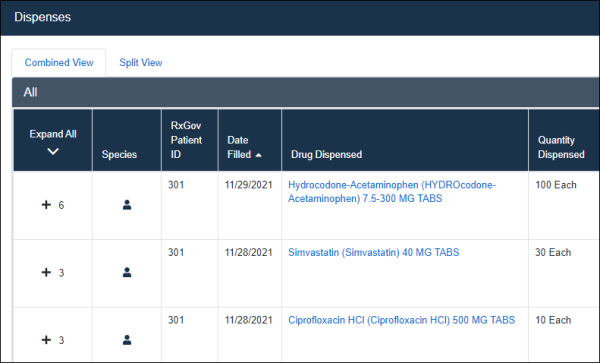
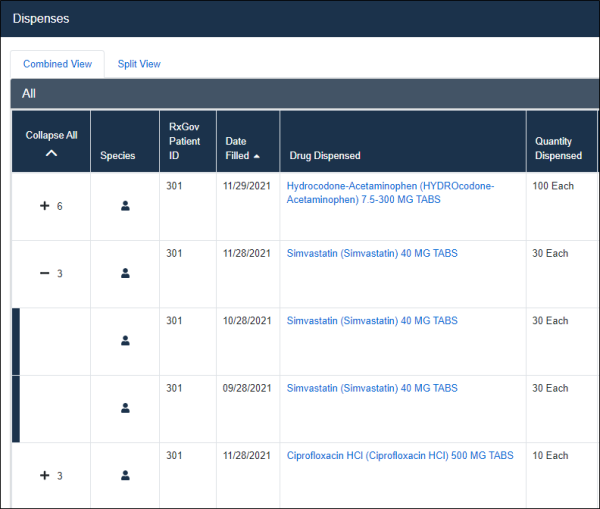
- To view details for a single dispense, click the name of the drug displayed in the Drug Dispensed column to display the Dispense Details.
- Click the X to return to the Dispense Results screen. If no dispenses are found, RxGov displays the Query returned no results message. For individuals not found in RxGov, the No patients found for State message is displayed.
Query parameters can be broadened to capture expanded results. In cases where the order of the patient name is uncertain, the query can be submitted to search for the name in any order. For example, if the patient name is listed as Mason Morgan, but could also be listed as Morgan Mason, the query can be configured to find all combinations.
To have the query search for names in any order, select the Search for any first and last name combinations checkbox in the Patient Query section.
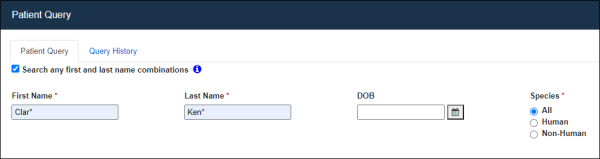
An additional search option, Search by Partial Name, may be available, subject to the configuration determined by the state PDMP.
To search by partial name for First Name, Last Name, or both, type the known letters in each field, followed by an asterisk, and click Submit (The minimum number of letters required for a search is determined by your state PDMP.).
*Note: If the number of letters entered is too few, a message is displayed, indicating the minimum number of letters required for the search.
Patient Relationships
Once a query is run, the relationship information between Dispensers and Prescribers is viewable in the Relationships tab in the Patient Query section.
Complete the following steps to view the relationships between Dispensers and Prescribers:
- In the Patient Results section of the query, select the checkbox to the left of a patient name to display details about that patient dispense.
- In the Patient Information section, click the Relationships tab to display further information. This tab defaults to the pie chart view and the number of past months selected in the Dispense Details filter.
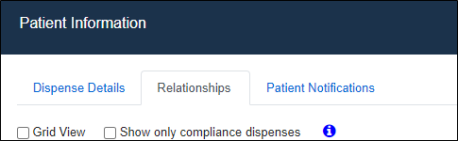
- In the pie chart view, hover over a color to see Dispenser or Prescriber details.
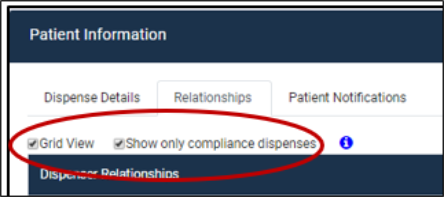
- (Optional) Select the Show only compliance dispenses checkbox to change the pie chart view to display only compliance dispenses.
- (Optional) Select the Grid View checkbox to view the relationship data in a table format.
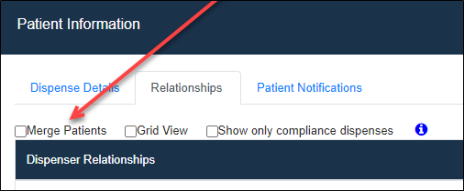
- (Optional) When viewing multiple records for the same patient (for example, when vet dispenses are also returned), select the Merge Patients checkbox to combine records displayed in the pie charts.
- View the displayed pie charts.
*Note: All dispenses found for the associated patient records are displayed in one Dispenser and one Prescriber pie chart to provide a single visual for each set of relationships.
Patient Notifications
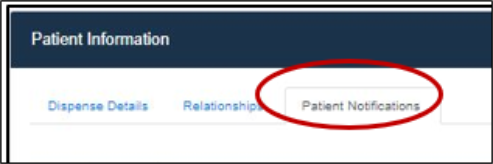
Notifications for prescriptions dispensed to the patient selected from the query results are available to view in the Patient Notifications tab under the Patient Information section.
Report Patient Issue
Prescribers can submit a Report Patient Issue ticket to the state Prescription Drug Monitoring Program (PDMP) Administration.
Complete the following steps to submit a Report Patient Issue ticket:
- In the Patient Results section of the query, click Report Patient Issue.
- On the Create Patient Ticket window, in the Comment section, enter the message in the text field.
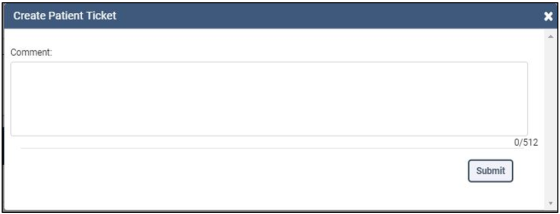
- Click Submit.
- Review the displayed Success window.
- (Optional) To view tickets, open the Tickets menu on the main Prescriber Engine page.
Flag for Merge
Prescribers can submit a Flag for Merge ticket in cases where duplicate patient records in RxGov are identified. Upon submission of Flag for Merge tickets, PDMP Administration reviews and merges the patient records to consolidate the dispense data.
Complete the following steps to submit a Flag for Merge ticket:
- In the Patient Results section of the query, select the checkbox to the left of the patient record(s) for all associated records to flag the record(s) for merge.
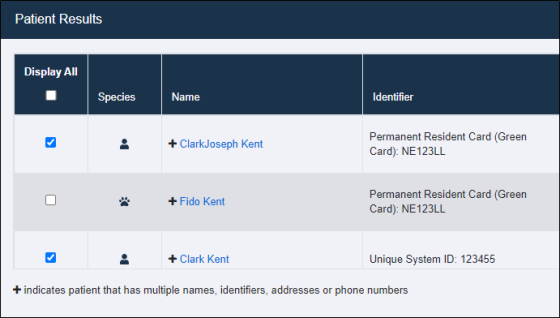
- Click Flag for Merge.
- On the Create Merge Patients Ticket window, in the Comment section, enter the message in the text field.
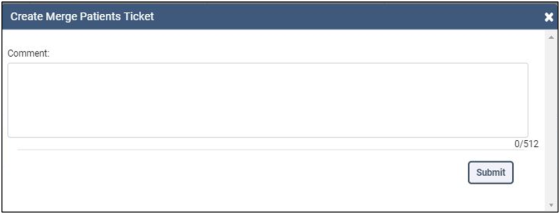
- Click Submit.
- Review the displayed Success window.
- (Optional) To view tickets, open the Tickets menu on the main Prescriber Engine page.
*Note: Patient Merge tickets are not viewable by Prescriber Delegates once submitted. Submitted tickets are only visible to the Prescriber.
Query History
A query history is available for all queries performed by a Prescriber. On the main Prescriber Engine page, in the Query section, select the Query History tab to access historical queries.
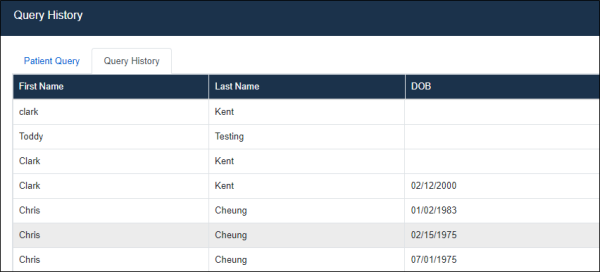
Rerun a Query
To rerun a query, click anywhere in the row of the displayed historical query. When the historical query is clicked, the original query screen is displayed with the original parameters pre-populated. Click Submit to rerun the query.
Prescription Notifications
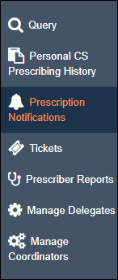
Prescription Notifications alerts a prescriber to patients with the four prescription dispensing activity notification types listed. This assists prescribers in monitoring both their own prescribing as well as patient activity for easier oversight of prescribing within their patient population.
Notification Types:
- New prescriptions dispensed from any Prescriber, including the Prescriber.
- New prescriptions dispensed by the Prescriber only.
- New prescriptions dispensed from any other Prescriber only.
- New prescriptions dispensed from a new Dispenser.
Complete the following steps to create a notification for the patient:
- In the Patient Results section of the query, click Create New Prescription Notification.
- Enter the following content in the Subscribe to receive notifications on your patient’s prescription activity window:
- Select the notification type from the Notification Type drop-down menu.
- Set the number of months for the notification in the Expires In (Months) field. The default number of months is 6.
- Click Add Notification.
- (Optional) View the notifications on the main RxGov Prescriber Engine window, under the Prescriber Notifications menu.
Personal CS Prescribing History
The Personal CS Prescribing History feature displays a list of a Prescriber’s dispensed prescriptions up to a range of 120 days.
The default view on the Personal CS Prescribing History page in the My Prescriptions section displays thirty days of dispenses. Use the calendar menus for Start Date and End Date or enter a new date for either of those fields to filter dispenses. Click Run Query to generate query results.
*Note: The date range parameters entered for Start Date and End Date must be within the range established in the configuration. If a date range which exceeds that configuration is entered, an error message is displayed.

Select an option from the Past: drop-down menu to filter the query range. Each line provides basic details of the prescription. Click the row displaying a dispensed prescription to display the Dispense Details window and view additional patient and dispense details. Click the column header, then click the white arrow to sort column data.
Tickets
The Tickets menu displays all Prescriber tickets sent to Prescription Drug Monitoring Program (PDMP) Administration for approval. For example, user identifier change requests, patient issues, and patient merge requests.
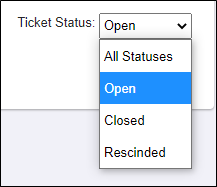
Tickets can also be sorted by status. Select an option from the Ticket Status drop-down menu to sort the displayed tickets by status.
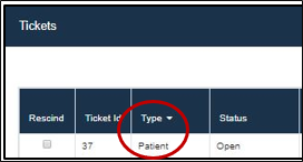
Tickets can also be sorted by column content. Click a column header, then click the arrow to sort the contents of a column.
 Note: Any tickets submitted on behalf of a Prescriber are not viewable by the Prescriber Delegate once submitted and are not displayed in the Tickets query.
Account Assistance
The main RxGov menu bar and main login window provides useful tools to update user profile details, update passwords, recover forgotten passwords, and to view account lockout and system notifications.
Update User Profile Details
Complete the following steps to update user profile details:
- On the RxGov menu bar, select the displayed username.

- On the displayed User Profile Details page, make necessary changes to existing content.
*Note: The Email field content cannot be changed.
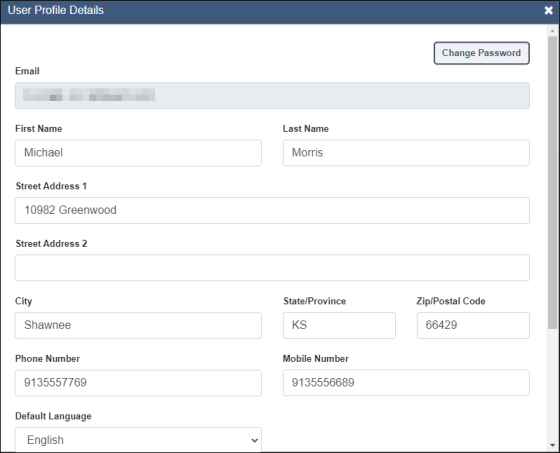
*Note: The user can select which language to use in RxGov as the default language if the Config Admin has enabled this feature. Use the drop-down menu on the User Profile Details window to select the appropriate language, then click Save.
- Click Save.
 (Prescribers Only): Changes to the Prescriber Identifier fields (CDS, DEA, NPI, Organizations, Specialty, State License, and User Type) must go through PDMP Administration. To initiate the process, click Change Identifier Fields in the User Profile Details window
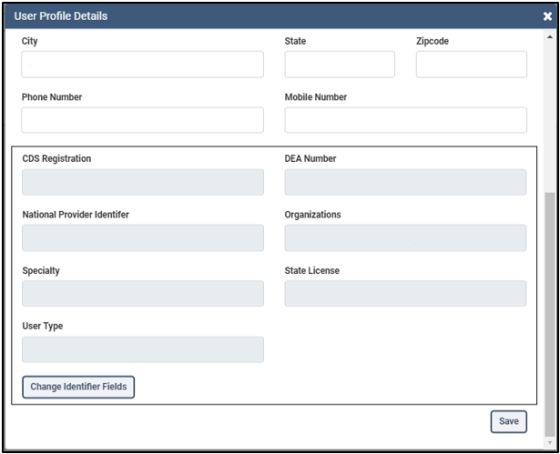
- Enter an explanation and other necessary criteria for the change in the displayed Create User Identifier Change Request Ticket window.
*Note: DEA number format and DEA file validation is automatically verified upon number entry during a profile edit. Incorrect format entry disables the Submit button until a correctly formatted number is entered. If the DEA file validation fails, an error is displayed, but profile updating may continue.
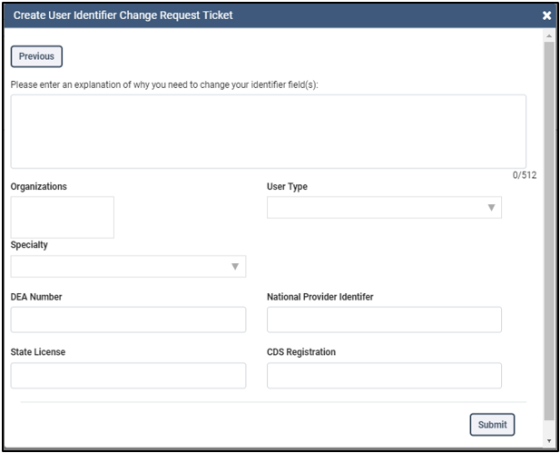
- Click Submit.
- View the message in the displayed Success window to verify that the change was successfully submitted.
When the requested change is approved by an Admin, an email is sent to the email address associated with the account profile.
Updating Your Password
Passwords may be updated when a user is logged into the system. For security, it is highly encouraged to change passwords every three months. Also, the password used for the RxGov account should not be the same as the password used for any other account.
Complete the following steps to change a password:
- On the RxGov menu bar, select the displayed username.

- On the User Profile Details page, click Change Password.
- In the Current Password field, enter your current password.
- In the New Password field, enter the new password.
*Note: Password cannot be the same as any of the previous six passwords used.
- In the Confirm New Password field, confirm the new password.
- Click Change Password to confirm the update.
- In the displayed Success window, confirm the successful password change.
Forgot Password
If a user forgets their password and cannot continue with the login process, a password change must be requested.
Complete the following steps to request a new password when a current password is forgotten:
- On the main RxGov login window, select the Forgot password? link.
- Review the email that is sent to the email address associated with the user account. Click the link provided in the email message to reset the password for RxGov.
- In the Password field, enter the new password.
*Note: Passwords must be at least eight characters in length, contain uppercase and lowercase characters, and contain at least one special character, and one digit. - In the Confirm Password field, enter the same password entered in the Password field.
- Click Enter.
- Review the displayed Success window to confirm the successful password change.
Account Lockout
After five failed login attempts, the user account is locked out. Locked accounts remain locked for 30 minutes, or until the user contacts the state PDMP Admin to unlock the account.
When an account is locked out, the following Account Locked window is displayed:

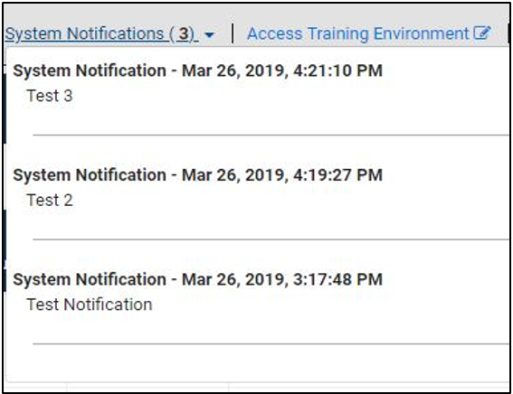
System Notifications
System notifications are set by System Administrators, visible to all users, and usually contain information about updates, system outages, or planned downtime. The notifications may also contain information relevant to use of the system.
View System Notifications
Select System Notifications on the top menu bar to view system notifications.